At NTT, we are committed to being more than just a grantmaker. We recognise that traditional grantmaking often perpetuates hierarchical power dynamics, wherein external donors impose solutions on communities. In contrast, our approach is rooted in local leadership, participatory processes, and human rights principles. We prioritise community-driven initiatives, ensuring that those most affected by issues are at the forefront of decision-making.
We view our role as partners, not gatekeepers, working alongside communities to co-create solutions that are contextually relevant and sustainable. This collaborative model challenges the conventional donor-recipient relationship, fostering mutual respect and shared accountability. By embracing this approach, we aim to empower communities, uphold their dignity, and contribute to a more just and equitable society.
Our Footprint
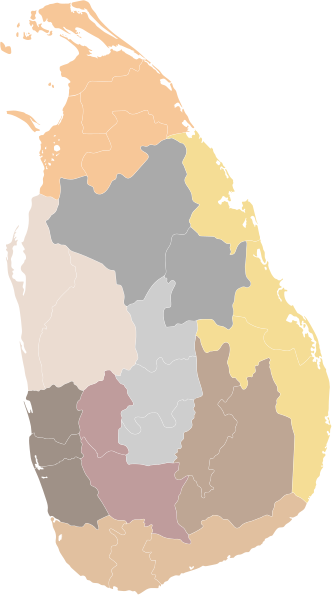
Spanning diverse regions across Sri Lanka, this map illustrates NTT’s footprint as a local grantmaker, highlighting partnerships with community-based organisations and grassroots actors. It reflects a commitment to equitable resource distribution and to strengthening civil society ecosystems through responsive and context-driven grantmaking approaches.
58 Partners
Economic Justice | Gender Justice | Access to Legal Remedies | Emerging Issues | Solidarity | Health Equity | Disability Rights | Care | Citizenship | Public Institutions and Accountability
Emerging Issues | Solidarity | Economic Justice | Gender Justice | Access to Legal Remedies | Health Equity | Disability Rights | Care | Citizenship | Public Institutions and Accountability
Economic Justice | Gender Justice | Access to Legal Remedies | Emerging Issues | Solidarity | Health Equity | Disability Rights | Care | Citizenship | Public Institutions and Accountability
Global NPO Coalition on the Financial Action Task Force (FATF)
The Global NPO Coalition on FATF is a network of nonprofit organisations (NPOs) advocating for fair anti-money laundering and counter-terrorist financing (AML/CFT) policies. It works to protect civil society from the negative impacts of FATF regulations, specifically to prevent the misuse of Recommendation 8 (R8) against charity work. The Coalition, which is also known as the FATF NPO Coalition or the NPO Coalition, often engages directly with the FATF.
Global Campaign to Decriminalise Poverty and Status
The Global Campaign to Decriminalise Poverty and Status is an international coalition dedicated to abolishing laws and enforcement practices that criminalise people for their socioeconomic status, identity, or activism. It targets outdated colonial-era laws, such as vagrancy, loitering, begging, sedition, and public order offences, and current laws which disproportionately affect marginalised groups, including people in poverty, women, homeless individuals, migrants, sex workers, LGBTQIA+ persons, and others. Through litigation, advocacy, legal guidance, regional convenings, and strategic resources, the Campaign aims to reform laws rooted in colonial legacies and to support marginalised communities globally.
WINGS
WINGS is the only global network of philanthropy support and development organisations. It is a community of more than 230 thought leaders and changemakers across 60 countries committed to growing and strengthening philanthropy to ensure it reaches its fullest potential as a catalyst for social progress. WINGS is committed to ending inertia, breaking down silos, challenging conventional wisdom, and creating an enabling environment for philanthropy to flourish. Its goal is to encourage collaboration and ignite potential—to rally philanthropic actors everywhere to build a more just, equitable, and sustainable world. NTT is also a leading member of the WINGS Asia Pacific Co-Group.
Human Rights Funders Network
The Human Rights Funders Network (HRFN) is a global community of over 450 grantmaking institutions from more than 70 countries, working together to advance human rights through collaborative and movement-centred philanthropy. Founded in 1994, HRFN connects funders across foundations, donor networks, and institutions to share knowledge, shift power and resources to grassroots movements, and strengthen justice-focused grantmaking. Guided by values of accountability, transparency, racial justice, and collective care, HRFN promotes open philanthropy through research on funding trends, practical grantmaking principles, peer learning spaces, and global convenings. By centering marginalised voices and fostering collaboration, HRFN is reshaping the human rights funding ecosystem to be more inclusive, just, and responsive.
Shift The Power/Possible Now
The #ShiftThePower movement is a global campaign challenging top-down philanthropy and international development, advocating for power to be shifted to local communities and actors. It seeks to replace traditional, bureaucracy-heavy aid models with equitable partnerships, focusing on trust, local assets, and collective action to achieve sustainable, community-led change. The movement highlights that the traditional aid system is unsustainable and often ineffective, requiring a shift toward solutions that honour local expertise and dignity. It emphasises that communities are best positioned to define their own development, requiring donors to change from a mindset of control to one of partnership.
Foundations for Peace Network
Foundations for Peace Network (FFPN) is a coalition of locally rooted peacebuilding foundations across conflict-affected societies. Since its launch in New York, it has grown into a platform facilitating mutual support, knowledge sharing, and advocacy for locally driven peace processes. The network prioritises empowering victims, involving women and youth, and reinforcing community-based philanthropy as catalysts for sustainable, authentic peacebuilding. NTT is a founding member of FFPN.
ENGLISH
ENGLISH
TAMIL
SINHALA
95 Partners
Economic Justice | Gender justice | Access to legal remedies | Emerging issues | Solidarity | Health equity | Disability rights | Care | Co-existence | Narratives | Knowledge | Citizenship | Public institutions and accountability
Economic Justice | Gender justice | Access to legal remedies | Emerging issues | Solidarity | Health equity | Disability rights | Care | Citizenship | Public institutions and accountability
Emerging issues | Solidarity | Economic Justice | Gender justice | Access to legal remedies | Health equity | Disability rights | Care | Citizenship | Public institutions and accountability
Economic Justice | Gender justice | Access to legal remedies | Emerging issues | Solidarity | Health equity | Disability rights | Care | Citizenship | Public institutions and accountability