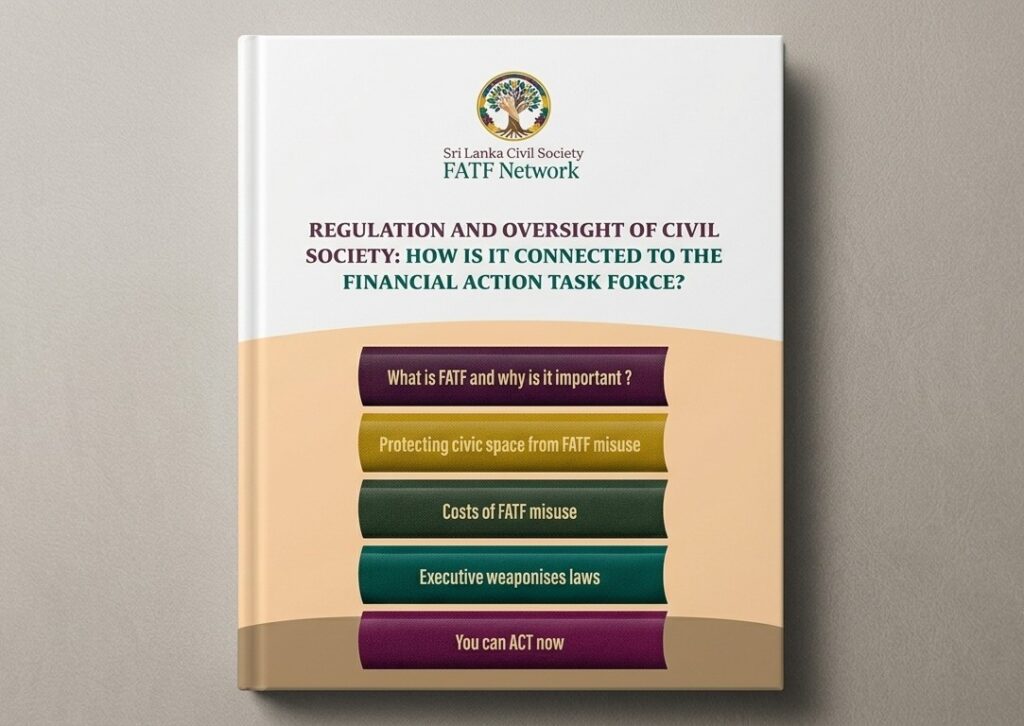
📢 UPDATED EXPLAINER! – Regulation and Oversight of Civil Society: How is it Connected to the Financial Action Task Force (FATF)?
We have updated the explainer to include a new section on Sri Lanka’s draft NGO (Registration and Supervision) law. The addition explains critical parts of the draft law and demonstrates how several provisions that bestow broad, punitive powers on state officials, particularly the police, contravene FATF’s standards.
FATF is the international body that sets standards to fight money laundering and terrorist financing (AML/CFT). If a country fails to meet these standards, it can be found non-compliant or partially compliant and even being grey or black listed. Such outcomes can adversely impact and undermine trust in the economy by reducing foreign investment, raising borrowing costs, and making international banking difficult.
In Sri Lanka, FATF standards are being misapplied and being used to justify blanket rules and practices that restrict civic activity. These actions prevent civil organisations, including charities and those providing humanitarian assistance from accessing bank accounts and foreign donations. This in turn disrupts their work, hurts vulnerable communities, and places heavy administrative burdens on local banks and small businesses.
The Sri Lankan government has used the pretext of FATF compliance to introduce the draft NGO law, which requires a broad range of entities including any group of more than five persons engaged in a non-profit activity to register and re-register every three years. It creates a Competent Authority which is empowered to interfere in civic activities and impose heavy penalties. The police are also empowered to inspect premises of non-profit entities without warrants, attend executive committee meetings, and suspend operations over vague claims related to national security. Limiting registration validity to just three years creates severe operational uncertainty, undermines freedom of association, and contravenes FATF Recommendation 8 on Non-Profit Organisations (NPOs), which requires risk-based, focused, and proportionate measures rather than broad, arbitrary and repressive regulations.
Sri Lanka is at present undergoing an evaluation by FATF to assess whether its laws, systems and processes are in adherence to FATF standards. It is hence imperative the government ensures it is in compliance with FATF standards, including Recommendation 8 on NPOs.
This explainer covers the following key areas using easy-to-understand scenarios:
📌 What is FATF and why it matters
📌 How Sri Lanka’s AML/CFT laws, policies and practicies contravene FATF guidelines.
📌 How FATF Recommendation 8 protects civil society.
📌 The costs and impact of misusing FATF.
👉 Click here to read the full Explainer: English | සිංහල | தமிழ்
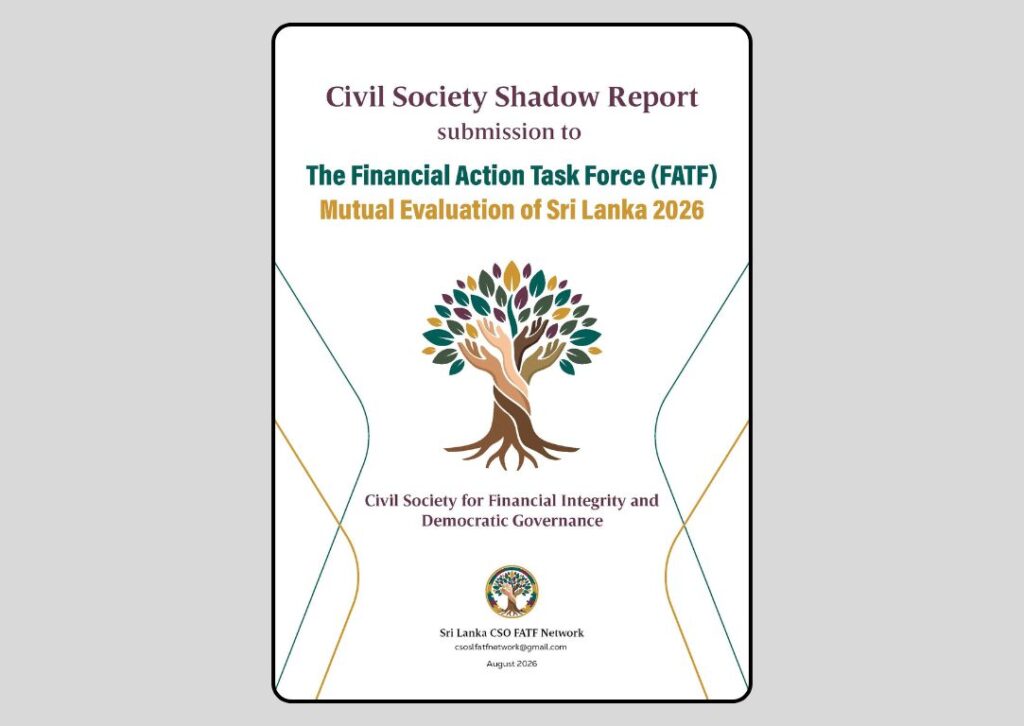
Sri Lanka Civil Society FATF Network submitted a shadow report to the Financial Action Task Force (FATF) for the Mutual Evaluation of Sri Lanka this year, raising concerns about the implementation of measures affecting the non-profit organisation (NPO) sector.
The report examines how FATF standards are increasingly being used to justify repressive legislative, regulatory and administrative measures that go beyond addressing identified terrorist financing risks.
Key concerns include:
These developments are particularly significant in the context of FATF Recommendation 8, which requires countries to assess, identify and understand the terrorist financing risks to which NPOs are exposed and to apply risk-based, focused and proportionate measures to address those risks.
The FATF standards are not intended to result in arbitrary, blanket measures against the NPO sector or to disrupt legitimate NPO activity.
The shadow report therefore calls for Sri Lanka’s AML/CFT framework to be implemented in a manner that is genuinely risk-based, focused and proportionate with appropriate safeguards against unintended consequences, including financial exclusion and de-risking.
The report also highlights the need to distinguish between legitimate civil society activity and activity that presents an identified terrorist financing risk.
Click here: Civil Society Shadow Report submission to FATF – Mutual Evaluation of Sri Lanka – August 2026
Regulation and Oversight of Civil Society: How is it Connected to the Financial Action Task Force (FATF)?
FATF is the global body that sets standards for policies to combat money laundering and terrorist financing (AML/CFT). Failing to comply with FATF standards can have negative consequences for a country, such as being grey listed, which will adversely impact its economy.
The government of Sri Lanka is using FATF to impose blanket and arbitrary restrictive regulatory measures on NGOs that restrict their access to banking services and funds. This not only disrupts their legitimate operations but also harms the vulnerable communities they serve. The proposed law reforms will place disproportionate administrative burdens on banks and other financial institutions as well.
As Sri Lanka is undergoing an assessment (called a mutual evaluation) by FATF this year, we are raising awareness on this process and how to advocate for AML/CFT policies that adhere to FATF standards.
This explainer tells you:
✅What is FATF is and why it matters?
✅Whether GoSL’s AML/CFT policies contravene FATF.
✅How FATF Recommendation 8 protects civil society
✅The costs of misusing FATF
✅Proposed amendments to AML/CFT laws that do not adhere to human rights standards and place disproportionate administrative burdens on banks and other financial institutions
✅What you can do to counter this
Click here : Explainer! – Regulation and oversight of civil society-How is it connected to the financial action task force

1-2 September 2025
NTT convened a two-day virtual discussion last year to present research emerging from its Macroeconomic Fellowship. The convening brought together economists, researchers, civil society actors, and policymakers to engage with critical questions at the intersection of macroeconomic policy and socio-economic rights in Sri Lanka.
Across multiple sessions, fellows presented their research, followed by reflections from senior economists and practitioners. The discussions explored issues such as regional inequalities in growth, governance and accountability gaps, labour rights within export-oriented sectors, the gendered impacts of tax reforms, and the implications of trade policies on informal livelihoods.
The convening was designed not only as a platform for presenting research, but as a space for dialogue and critical engagement. Participants were invited to reflect on how macroeconomic decisions shape lived realities, particularly for communities facing multiple and intersecting vulnerabilities.
As part of its broader discourse-building work, NTT initiated the Macroeconomic Fellowship to address the gap in economic policy research grounded in a human rights framework. The convening reinforced the importance of connecting rigorous, independent research with community realities, ensuring that policy debates remain informed by the experiences and needs of those most affected.
Click here to download the compilation of fellowship papers.
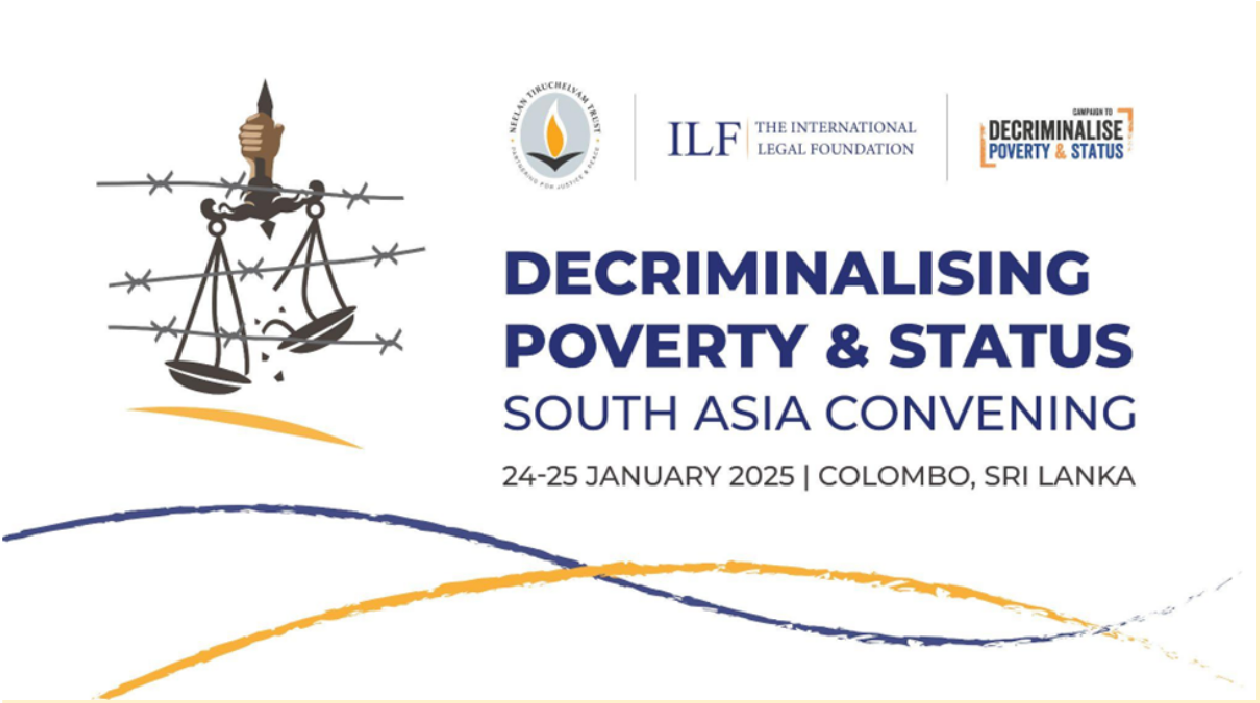
24-25 January 2025
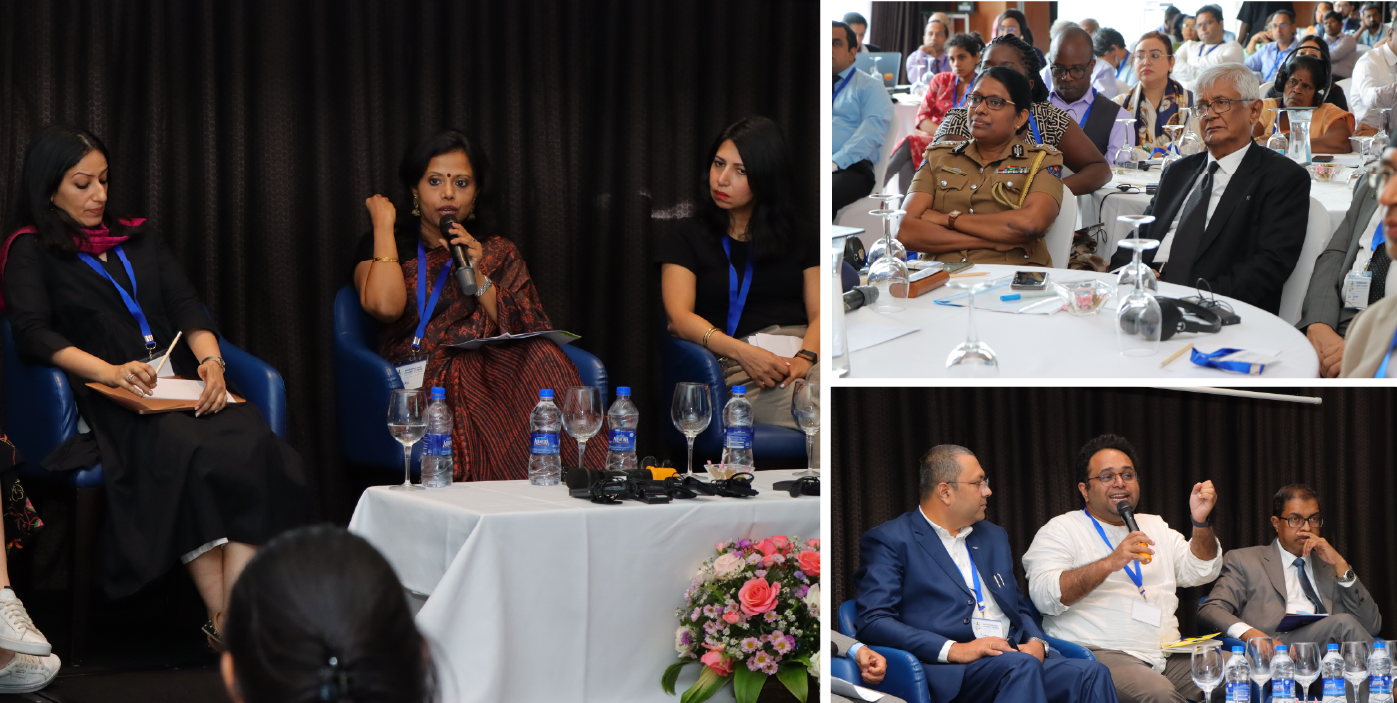
This first South Asian Convening on Decriminalising Poverty and Status brought together organisations and activists engaged in national and regional efforts to decriminalise poverty, status and/or activism in their respective communities. Discussions over two days saw participants reframing narratives regarding criminalisation and the criminal justice system while understanding common challenges and sharing strategies to address them.
The convening was held in Sri Lanka on 24-25 January 2025, jointly organised by the NTT and the International Legal Foundation (ILF). NTT and ILF are members of The Global Campaign to Decriminalise Poverty and Status – a coalition of organisations advocating for the repeal of laws and reform of policies and practices that target people based on poverty, status or for their activism.
Themes that emerged during the discussion include the ways in which the existing legal system fails to protect vulnerable groups, and the role states play in this by weaponising the criminal justice system to restrict the rights of its citizens. The complicity of society, including civil society organisations (CSOs), in this through their failure to critically engage with the system and hold it accountable was highlighted.
These discussions led to sharing successful counterstrategies and good practices, including areas for potential collaboration to decriminalise survival behaviours and protect marginalised and oppressed communities in the region.
Access the full rapporteur report: Decriminalising Poverty and Status event report.pdf