ENGLISH
  • English
  • Tamil
  • Sinhala
August 2026

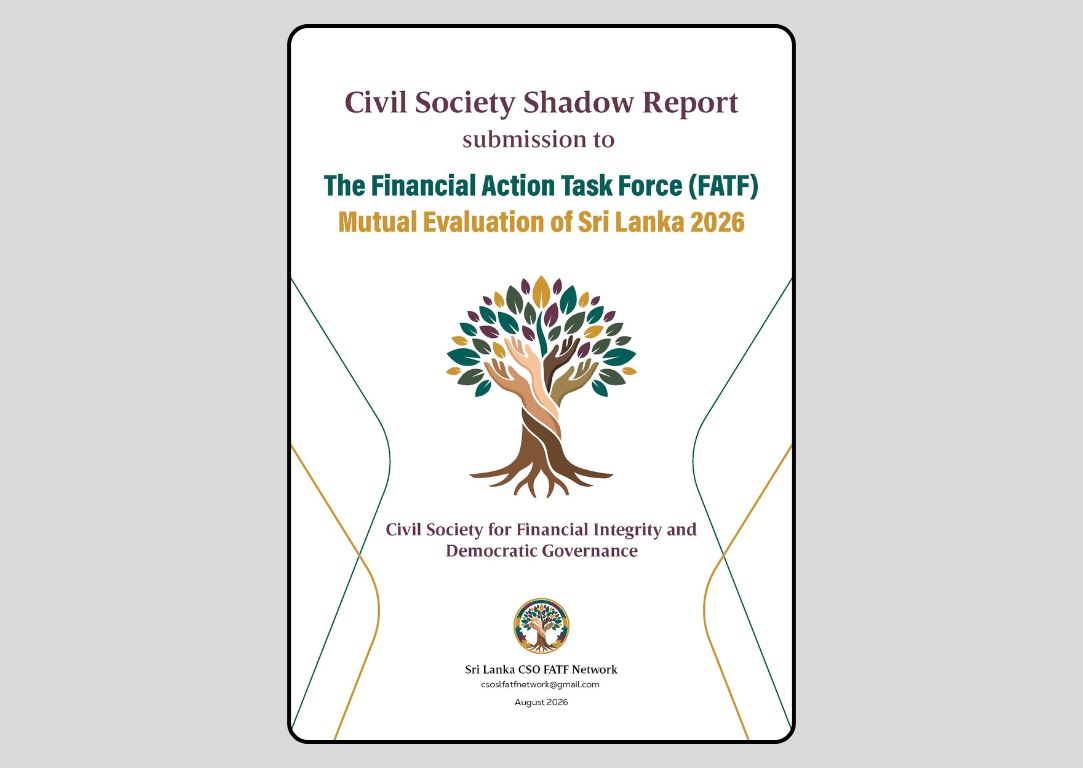
Civil Society Shadow Report submission to FATF – Mutual Evaluation of Sri Lanka – August 2026

Sri Lanka: Civil Society Shadow Report to FATF for the Mutual Evaluation of Sri Lanka 


Sri Lanka Civil Society FATF Network submitted a shadow report to the Financial Action Task Force (FATF) for the Mutual Evaluation of  Sri Lanka this year, raising concerns about the implementation of measures affecting the non-profit organisation (NPO) sector.


The report examines how FATF standards are increasingly being used  to justify repressive legislative, regulatory and administrative measures that go beyond addressing identified terrorist financing risks.


Key concerns include:

  • The proposed NGO law which requires mandatory registration of a broad range of entities and even community groups that engage in social services. 
  • Extensive supervisory, investigative and enforcement powers bestowed upon the executive without adequate judicial oversight and due process safeguards.
  • Administrative sanctions imposed without following due process that will have significant consequences for NPO operations.
  • Arbitrary and blanket provisions that  restrict access to financial services that will contribute  to financial exclusion and de-risking.
  • Enhanced scrutiny, reporting and surveillance of NPOs, including by security agencies, without reasonable suspicion of terrorist financing.
  • The cumulative securitisation of the NPO sector and contraction of civic space.


These developments are particularly significant in the context of FATF Recommendation 8, which requires countries to assess, identify and understand the terrorist financing risks to which NPOs are exposed and to apply risk-based, focused and proportionate  measures to address those risks.


The FATF standards are not intended to result in arbitrary, blanket measures against the NPO sector or to disrupt legitimate NPO activity.


The shadow report therefore calls for Sri Lanka’s AML/CFT framework to be implemented in a manner that is genuinely risk-based, focused and proportionate with appropriate safeguards against unintended consequences, including financial exclusion and de-risking.


The report also highlights the need to distinguish between legitimate civil society activity and activity that presents an identified terrorist financing risk.

Read More

Regulation and Oversight of Civil Society: How is it Connected to the Financial Action Task Force (FATF)?

FATF is the global body that sets standards for policies to combat money laundering and terrorist financing (AML/CFT). Failing to comply with FATF standards can have negative consequences for a country, such as being grey listed, which will adversely impact its economy.

Macroeconomic Policy and Socioeconomic Rights in Sri Lanka

This publication is a compilation of five research studies, conducted as part of NTT’s Macroeconomic Policy and Socioeconomic Rights Fellowship. They examine the human rights impacts of Sri Lanka’s economic crisis and recent macro economic policy changes. The reports explore regional inequalities in growth, governance and accountability gaps, labour rights in export industries, the gendered effects of tax reforms, and the impact of trade liberalisation on informal livelihoods, and offer critical insights into how economic decisions shape the lives of ordinary people.

Virtual Convening on Macroeconomic Policy and Socioeconomic Rights in Sri Lanka

NTT convened a two-day virtual discussion last year to present research emerging from its Macroeconomic Fellowship. The convening brought together economists, researchers, civil society actors, and policymakers to engage with critical questions at the intersection of macroeconomic policy and socio-economic rights in Sri Lanka.
ENGLISH
  • ENGLISH
  • TAMIL
  • SINHALA