
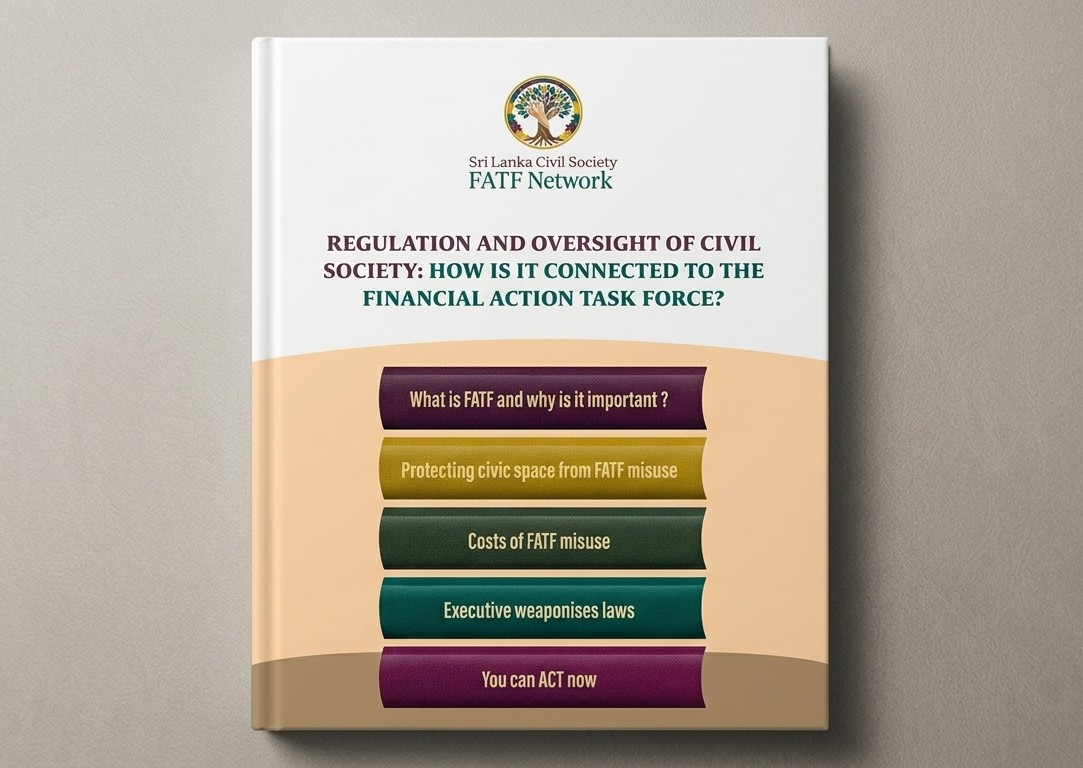
UPDATED EXPLAINER! – Regulation and Oversight of Civil Society: How is it Connected to the Financial Action Task Force (FATF)?
We have updated the explainer to include a new section on Sri Lanka’s draft NGO (Registration and Supervision) law. The addition explains critical parts of the draft law and demonstrates how several provisions that bestow broad, punitive powers on state officials, particularly the police, contravene FATF’s standards.
FATF is the international body that sets standards to fight money laundering and terrorist financing (AML/CFT). If a country fails to meet these standards, it can be found non-compliant or partially compliant and even being grey or black listed. Such outcomes can adversely impact and undermine trust in the economy by reducing foreign investment, raising borrowing costs, and making international banking difficult.
In Sri Lanka, FATF standards are being misapplied and being used to justify blanket rules and practices that restrict civic activity. These actions prevent civil organisations, including charities and those providing humanitarian assistance from accessing bank accounts and foreign donations. This in turn disrupts their work, hurts vulnerable communities, and places heavy administrative burdens on local banks and small businesses.
The Sri Lankan government has used the pretext of FATF compliance to introduce the draft NGO law, which requires a broad range of entities including any group of more than five persons engaged in a non-profit activity to register and re-register every three years. It creates a Competent Authority which is empowered to interfere in civic activities and impose heavy penalties. The police are also empowered to inspect premises of non-profit entities without warrants, attend executive committee meetings, and suspend operations over vague claims related to national security. Limiting registration validity to just three years creates severe operational uncertainty, undermines freedom of association, and contravenes FATF Recommendation 8 on Non-Profit Organisations (NPOs), which requires risk-based, focused, and proportionate measures rather than broad, arbitrary and repressive regulations.
Sri Lanka is at present undergoing an evaluation by FATF to assess whether its laws, systems and processes are in adherence to FATF standards. It is hence imperative the government ensures it is in compliance with FATF standards, including Recommendation 8 on NPOs.
This explainer covers the following key areas using easy-to-understand scenarios:
Click here to read the full Explainer: English | සිංහල | தமிழ்